Showing posts with label Paris 1951. Show all posts
Showing posts with label Paris 1951. Show all posts
Tuesday, April 7, 2015
Paris 1951: Three Photographs
I've taken a closer look at the three photos that came in the envelope with the postcards and business cards.
All of the photos are black and white, printed on the standard glossy-front matte-back commercial photo development stock with scalloped edges, lighter but similar to the postcards.
One is of the Eiffel Tower taken from the Trocadero, the standard tourist shot except there are no people on the plaza and only three way off in the distance.
The other two, which I originally believed to be aerial shots, were, in fact, taken from the very summit of the tower itself. One is centered on the Arc de Triomphe, and the other is centered on Le Grand Palais with Sacre Coeur on the horizon. The back of the last one has "Eglise Sacre Coeur" handwritten in pen. The back of the Arc de Triomphe shot simply says "arch" in the same hand, and the one of the tower is blank.
I presume there was a whole roll (at least) taken in and around the city but these are the only ones in the envelope and there are no negatives to be found.
None of these additional landmarks are included in the postcard "tour" although La Madeleine is distinctly visible beyond Le Grand Palais and both Place Vendome and La Bourse (positively) and L'Arc du Carroussel (possibly) are within the span of the image if not discernible.
Hmmm. I just noticed that this last photo also encompasses the neighborhoods from the two business cards which, from this perspective, would be just below Montmartre and Sacre Coeur.
So, is it simple tourism that ties these all together? The handwriting on the photos and the business cards is different. I don't know who "Georges" is nor "M. Presse" (both from the business cards). And who was staying at the now defunct Hotel Metropole?

Monday, March 16, 2015
Paris 1951: Connecting the Dots
So far I've been concentrating on the two business cards and trying to learn something of the businesses they represented, but there are also a number of postcards in the envelope labelled Paris 1951. Ten of them, to be exact. And three photos, one of the Eiffel tower and two aerial shots.
All of the postcards seem to have been manufactured between the wars judging from the models of the cars and buses. They appear to be black and white photos, hand colored and printed on card stock
varnished on the illustrated side published by "E. R." with the notification "Paris" and "Reproduction Interdite." Most have a one-line description/title on the front, the rest have it on the back. Some are numbered.
 |
| La Madeleine - Present Day |
 |
| Place Vendome - c.1900 |
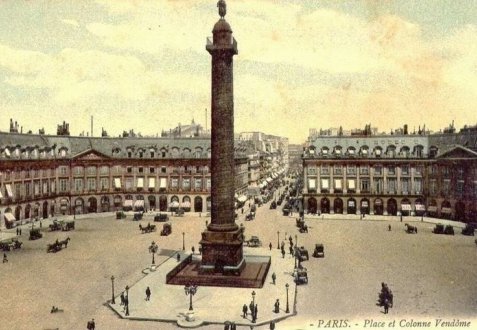
From west to east we start with the first card at the front portico of La Madeleine, the Greek style temple in the 8th arrondissement, facing east toward Boulevard des Capucines. The second card is Place Vendome, facing north looking directly at Napoleon on his column and, past him, up the Rue de la Paix. Both those streets meet at Place de l'Opera.
 |
| Le Louvre - c.1900 |
 |
| La Bourse - Present Day |
 |
| L'Hotel-de-Ville - Back Then (Even the trees are the same now) |
Card number six is a general view of Paris looking down the Seine. Aside from a background of low, gray, smoggy, obscuring haze worthy of 19th Century London (which the colorist has rendered in full lung-choking grit), the most notable feature of this card is not the seven bridges of the title but the fact that it looks west from just above L'Hotel-de-Ville to the location of the seventh card which is the only one that is no longer identifiable from its title.
 |
| Le Palais de Justice (5 Quai Horloge) - Present Day |
 |
| Pantheon looking up Rue Soufflot - Today |
 |
| Les Invalides |
The last two postcards are linked together and require a trip westward, still on the Left Bank, to a spot almost due south of where we started: Les Invalides. The first view is looking north at the exterior and dome. Once again the gardens in the card have been paved over although the building itself has been cleaned. The last card is Napoleon's Tomb.
If one traces this path on a map, starting at La Madelaine and proceeding generally in the shortest direction to the next card (La Bourse being the major exception), it forms a circuit around central Paris less than ten miles long, a kind of open sack with the Sorbonne at its bottom and Place de la Concorde and Quai D'Orsay in the open mouth.
Is there a story to go with this tour beyond a simple afternoon walkabout? Perhaps the three original photographs might help clarify.
Wednesday, January 28, 2015
Paris 1951: The American Connection
I have heard nothing back from Le Bistrot regarding the former occupant of their location, Au Porte d'Attache.
Today, I sent a similar request to the property management firm, G. Mauduit, which occupies the ground floor of, and presumably manages, the apartment building 36 rue Pigalle, the location of the late Morgan of Oregon, American Bar (The Only Yank in Montmartre). I am hopeful that a real estate firm may know more of the history of their property than a mere successor cafe, in the case of Le Bistrot, does.
My next step, if this line proves unfruitful, will be to try the Paris government property records. (The Hotel Metropole is no longer a hotel and I doubt any of the residents has the slightest knowledge of the history of the building. Also, I have no names or contact info for any of the residents, anyway.) I presume records of sale/purchase transactions, business licenses, etc. are all held at the city level and not the arrondissement.
I wonder what the possibilities of tracking down/identifying Mr. Morgan are?
UPDATE:
Imagine my surprise. I found a reference to Morgan of Oregon, of all places, in a copy of the June 2006 Pawcatuck Pilot, Official Newsletter of USS Pawcatuck AO-108 which reprints a section of a 1952 story of an apocryphal amalgamation of an engineer named "Alfred." As the tale recounts . . .
". . . His greatest sight was the Follies [sic] Bergere, in which he took part as a jockey on a wooden horse. After a day of events, he would always end up in Pigalle at Morgan’s of Oregon, an American bar. He would sit and talk for hours on end to anyone who was within earshot. After spending his last francs he would go to the door and leave and fall back at the sight, for outside was sunlight...then starting another day. After gathering his senses he would take his friend, Mrs. Morgan, and everyone else in the party to the Market Square for Onion Soup—the best in the world.. . ."
So, Mr. Morgan may, in fact, be Mrs. Morgan.
The game is afoot!
Tuesday, December 30, 2014
Paris 1951: The First Step
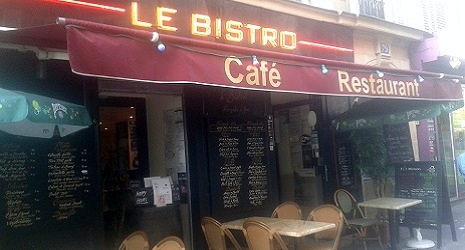
I found an e-mail address for Le Bistrot (it says "Bistro" on the awning out front but, apparently, the name is really "Bistrot") the cafe that currently lives in the space formerly occupied by Au Port d'Attache. In addition to some nice pictures, their web page lists several menus of traditional French cafe fare and if/when I can get to Paris they definitely seem worth checking out.
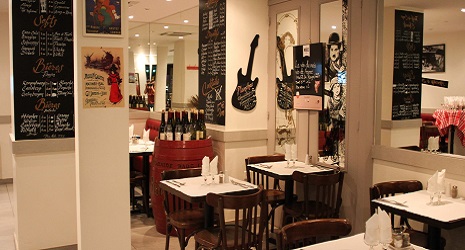
In the meantime, I sent an e-mail explaining the business card which came into my possession and asking if they knew anything at all about the history of their location. To date, I have heard nothing back. So, they either know nothing but are intrigued by my message and are researching whatever they can and will get back to me soon--or--they know something but are too busy during the holiday season right now and will get back to me when they can--or--they know something but are unable or unwilling to reveal what it is--or--they can't be bothered to respond to some stranger out of the blue with a sixty+ year old slip of paper that has nothing to do with their business. While the last possibility is the most likely, the third makes for a better story so that's the one I'll go with if they never get back to me.
After the first of the year, I will contact the real estate office that now occupies the former location of Morgan of Oregon. At the very least, they should know how to go about obtaining historical property records if they don't know the history themselves.
Friday, December 5, 2014
Paris 1951: The Investigation Begins
There are two business cards in the "Paris 1951" envelope my brother brought home. They're both oversize, closer to index cards than modern business cards.
The first one is for "Au Port d'Attache," 79 rue Blanche. The name is printed on a half ship's wheel and includes not only the probably unnecessary explanatory "Bar" on the hub but the invitation to "Venez Chanter." The telephone number is given as : Tri.: 64-89. "Paris 1951" is handwritten across the bottom in ink. The back contains the following note in penciled cursive:
M Presse,
108 Rue du Theatre
Hotel Metropole
chambre 48
Paris 15e
and vertically up the left side: metro Commerce.
The second card is for "Morgan of Oregon, American Bar." The upper left corner brags, "The only yank in Montmartre." The lower left corner touts "Hamburgers, Chile con Carne, Hot Dogs -- Bacon & Eggs." In the lower right corner are the address: 36, rue Pigalle, Paris 9e, the phone: Tel. Tri. 77-78, and the notice: "open all night from 17 hours" under which is handwritten in ink "1951." On the back are two calculations, in pencil, in a different hand from the first card. One is a multiplication, the other an addition (with the wrong answer). There is also the name "georges," and the words "Pont (or Port, the card was folded at one point and the crease runs right through the middle of the word) Royal."
108 rue du Theatre is no longer the Hotel Metropole, although it might have been at one point. It's a standard, anonymous six-story Parisian apartment building with a podiatrist's office on one side and a kitchen supply shop on the other. The Avenue Emile Zola metro stop is actually closer than Commerce but maybe didn't exist in 1951.
36 rue Pigalle is now a real estate agency.
As far as Pont/Port Royal is concerned: Pont Royal is both a bridge (which was obviously there in 1951) and a restaurant/cafe on the rue de Bac just off the bridge (which was probably not there then). Port Royal is a hotel on the boulevard of the same name. The hotel looks as if it could have been there then. At this point, there's no telling which interpretation of Port/Pont is correct.
Time for some historical digging.
Subscribe to:
Posts (Atom)
